

BBC News:
EU leaders meet in Brussels on Thursday for a summit overshadowed by Hamas’s war with Israel and the EU’s failure to project a united front.
For weeks, the European Union’s stance on the war has been clouded with mixed messages, diplomatic gaffes and conflicting national views on the Israeli-Palestinian conflict.
But after days of disagreement, EU leaders aim to project a united front.
They are expected to back a call for humanitarian pauses in the fighting.
European Council President Charles Michel says the deteriorating humanitarian situation in Gaza is of grave concern and the leaders are keen to facilitate access to food, water, medical care, fuel and shelter.
They hope that will create safer conditions for the release of more than 200 hostages seized by Hamas gunmen during their 7 October attack. Many of those held captive are European dual nationals, including citizens from Germany, France, Portugal and the Netherlands.
EU member states hold sharply differing views and it all makes for a very confusing picture.
Some have reservations about calling for a pause in the fighting and argue it could be seen as limiting Israel’s right to self-defence.
Germany and other countries do not support the idea of one, singular humanitarian pause, because that would be too close to the concept of a ceasefire, when Israel has the right to defend itself from attack.
What was needed instead were shorter breaks in the fighting, an EU diplomat told the BBC. “A pause means both actors stop for good, whereas pauses is temporary. It’s short intervals for a few hours, to get aid,” they said.
Germany, Austria, Hungary and the Czech Republic have taken strong stances of supporting Israel. Spain and Ireland are more attuned with the Palestinian cause.
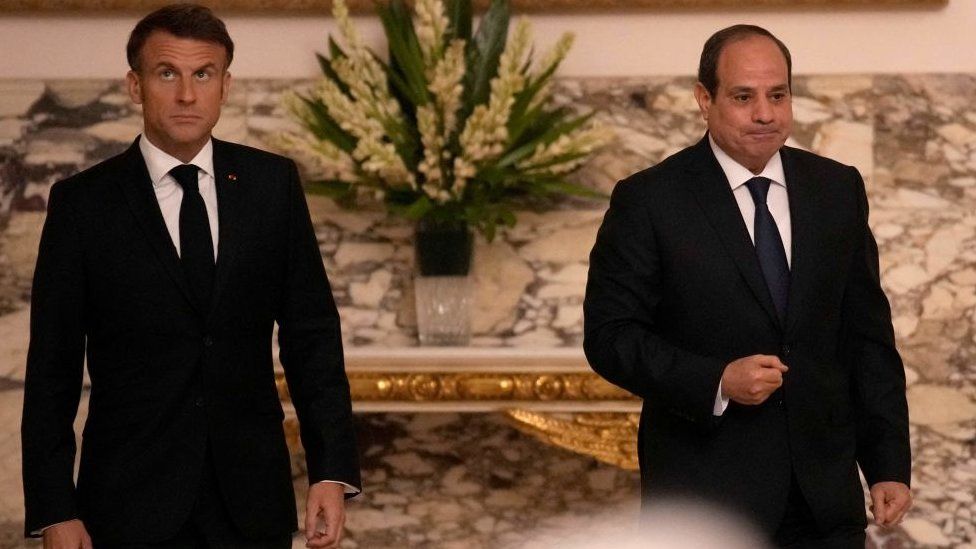
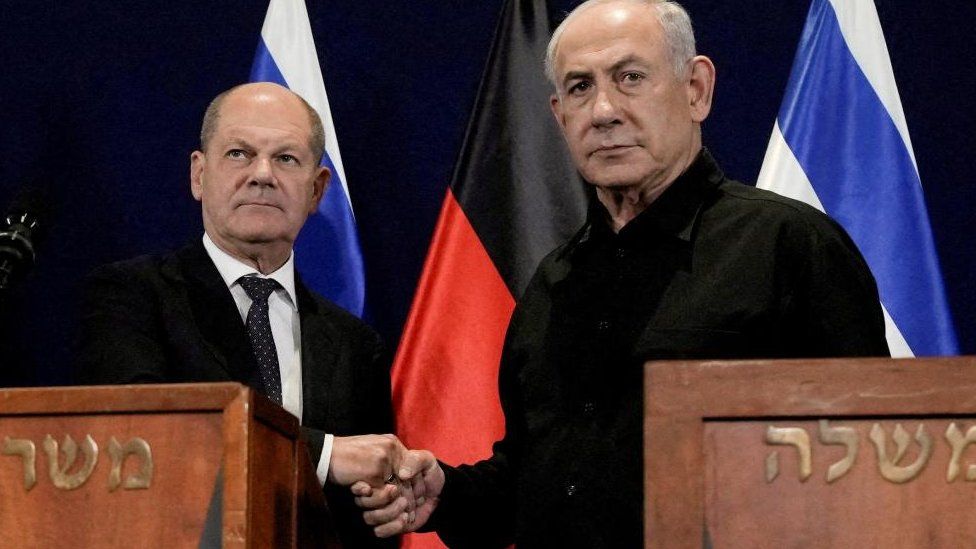
Several European leaders have been on a diplomatic tour of the Middle East. Italy’s Prime Minister Giorgia Meloni, German Chancellor Olaf Scholz and French President Emmanuel Macron have all had talks with Egypt’s President Abdel Fattah El-Sisi.
Austrian Chancellor Karl Nehammer and Czech prime minister Petr Fiala visited Israel on Wednesday.
Those differing views extend to the EU’s executive too.
The EU is the largest donor to the Palestinians, so when Oliver Varhelyi, Hungary’s European Commissioner responsible for policy towards neighbouring countries, announced after the Hamas attack that all payments were being suspended and all new budget proposals postponed, it immediately sent alarm bells ring at aid agencies.
The EC then rushed out a statement saying €691m (£600m) of aid would not be stopped but put under review, and later said it would treble aid for Palestinians.
And when European Commission President Ursula von der Leyen flew to Israel with the president of the European Parliament, she drew criticism for backing Israel’s right to defend itself without stressing that it should stick to international humanitarian law. There seemed to be no effort to connect with the Palestinian Authority.
However, an EU diplomat told journalists that not everything Ms von der Leyen said in Israel was posted on social media. “If you want to be effective, you don’t do megaphone diplomacy,” the diplomat said. “The Israeli government listens to us if we raise something behind closed doors.”
In a highly unusual move, more than 800 EU staff and diplomats signed an open letter criticising her “uncontrolled” support of Israel. They complained of the Commission’s “double standards”, pointing out that Russia’s blockade of Ukraine was seen as an act of terror, while Israel’s blockade of Gaza was “completely ignored”.
“The EU’s response has been rather unfortunate and very confusing,” James Moran from the Centre for European Policy Studies told the BBC.
“In the past, the EU approach to conflicts in the Middle East had generally managed to come out with an even-handed position. For example, in 2014 calls for a ceasefire were pretty quickly made.”
The EU doesn’t have an army, ships, or planes – but it has played an important diplomatic role in the Middle East.
When it was made up of just nine members in 1980, it issued the ground-breaking Venice Declaration recognising the Palestinian people’s right to self-determination.
Fast forward to 2023, the EU represents 27 countries with “fundamentally opposing views on the Middle East”, an EU diplomat told the BBC.
That became clear during an EU foreign ministers meeting earlier this week, where German Foreign Minister Annalena Baerbock reportedly argued against a humanitarian ceasefire because Hamas was still firing rockets at Israel.
As a result the EU has so far failed to agree on what kind of pause there should be.


 Users Today :
  Users Yesterday :
  This Month :
  This Year :
  Total Users : 1434545
 Views Today :
  Total views : 5000
 Who's Online :