

BBC News:
Every year, hundreds of North Korean defectors, who have since settled in the South, send much-needed money back home. But this is getting riskier as both countries are increasingly cracking down on illegal transfers of money.
“It is like a spy movie and people are putting their lives on the line,” says Hwang Ji-sung, who has been a broker in South Korea for more than a decade.
As a defector himself, he knows how complex and difficult the task is – requiring a covert network of brokers and couriers spread across South Korea, China and North Korea.
Secret calls using smuggled Chinese phones are made at remote locations. Code names are used.
The stakes are incredibly high – if caught, North Koreans risk being sent to the country’s dreaded political prison camps, known as kwan-li-so, where hundreds of thousands are believed to have died over the years.
A 2023 survey by the Database Center for North Korean Human Rights which polled about 400 North Korean defectors, found that around 63% had transferred money to their families in the North.
But since 2020, North Korean leader Kim Jong Un has intensified a crackdown on brokers to stop the flow of money and “reactionary ideology and culture” from South Korea.
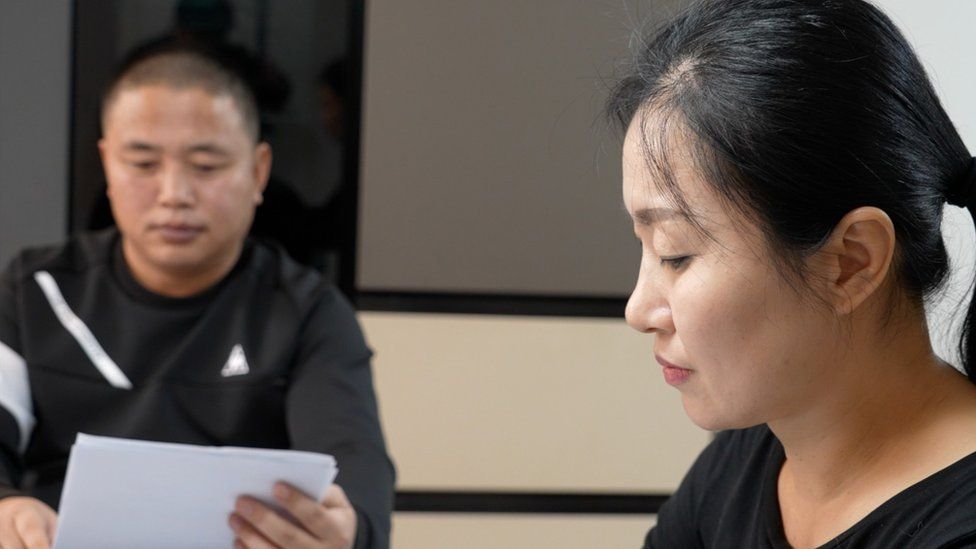
“The number of brokers in North Korea has gone down by more than 70% compared to a few years ago,” says Joo Soo-yeon, Mr Hwang’s wife. She is also a broker.
South Korea bans such transfers too, but in the past authorities have mostly looked the other way. Now that is changing.
Last April, Mr Hwang and Ms Joo’s home in Gyeonggi province – which is close to Seoul – was raided by four police officers, who accused her of violating the Foreign Exchange Transactions Act. Because the bank account that was used to send money to North Korea was in her name, she’s the one facing charges.
At least seven other brokers are also under investigation.
On-camera interviews with brokers are rare, but Ms Joo has chosen to speak to the BBC partly because she wants to publicise her case. The police have not responded to a BBC inquiry over her case.
South Korean authorities told Mr Hwang that any money transfer to North Korea should be carried out through a “legitimate bank”.
“If there is one, let me know!” he said, adding that there is no institution that can legally receive money in North Korea since the two Koreas are technically still at war.
Inter-Korean relations have been worsening since the North blew up a joint liaison office with the South in 2020. Earlier this month, North Korean leader Kim Jong Un even said it was no longer possible to achieve reunification with the South – a goal enshrined in the constitution.


 Users Today :
  Users Yesterday :
  This Month :
  This Year :
  Total Users : 1390631
 Views Today :
  Total views : 5000
 Who's Online :