
ABC:
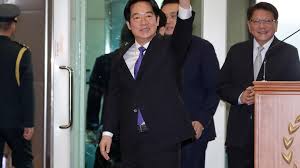
TAOYUAN, Taiwan — Taiwan’s president departed Saturday for his trip to the South Pacific that will include a two-day transit in the U.S., his first since assuming office, though few details about his itinerary were made public.
The planned stopovers in Hawaii and the territory of Guam have already drawn fierce criticism from Bejing, which claims Taiwan as its own territory and objects to official exchanges between it and the U.S., the island’s biggest backer and military provider.
Lai Ching-te will go on a weeklong trip to visit the Marshall Islands, Tuvalu and Palau — three diplomatic allies of the self-governed island in the Pacific.
“I want to use the values of democracy, peace, and prosperity to continue to expand our cooperation with our allies, to deepen our partnership and let the world see Taiwan not just as a model of democracy, but a vital power in promoting the world’s peace and stability, and prosperous development,” he said at the Taoyuan International Airport, ahead of his departure.
Though Taiwan retains strong contacts with dozens of other nations, it has only 12 formal diplomatic allies. The self-ruled democracy has recently been facing increasing pressure from China.
It is unclear whether Lai will meet with any members of the incoming U.S. administration during his transit.
President-elect Donald Trump said in an interview with Bloomberg in July that Taiwan should pay for its defense. The island has purchased billions of dollars of defense weaponry from the U.S. He also evaded answering whether he would defend the island from Chinese military action.
While the U.S. is obligated to help the island defend itself under the Taiwan Relations Act, it has maintained a position of strategic ambiguity over whether it would ever get involved if Taiwan were to be invaded by China.
A second Trump administration is expected to test U.S.-China relations even more than the Republican’s first term, when the U.S. imposed tariffs on more than $360 billion in Chinese products. Taiwan is one of the main sources of tension in the bilateral relationship.
Chinese Foreign Ministry spokesperson Mao Ning said on Friday if the U.S. wanted to maintain peace in the Taiwan Strait, it is important for it to handle the Taiwan issue “with utmost caution, clearly opposing Taiwan independence and supporting China’s peaceful reunification.”


 Users Today :
  Users Yesterday :
  This Month :
  This Year :
  Total Users : 1439247
 Views Today :
  Total views : 5000
 Who's Online :