

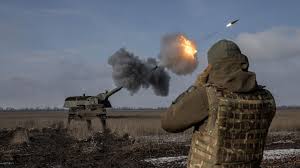
What happens today, here in Berlin, will impact the entire future of Europe’s defence and its ongoing support for Ukraine.
Germany’s Parliament, the Bundestag, is voting on whether to take the brakes off defence spending. This could pave the way for a massive uplift in military investment just as Russia makes gains in Ukraine and Washington signals that Europe can no longer rely on US protection.
“This vote in the Bundestag is absolutely crucial,” says Prof Monika Schnitzer, who chairs Germany’s Council of Economic Experts.
Advertisement
“After the Munich Security Conference, then the Trump-Zelensky row, Europe got a wake-up call. For the first time Europeans may not be able to rely on Washington. A lot of people had sleepless nights after that.”
“The outlook for European defence spending hinges on developments in Germany, as the holder of the region’s largest defence budget,” agrees Dr Fenella McGerty, senior fellow for defence economics at the London-based International Institute for Strategic Studies.
Defence spending in Germany rose by 23.2% last year, helping to drive a record 11.7% rise in European defence outlay.
“The remarkable initiatives announced in Germany are key to enabling further growth,” adds Dr McGerty.
“Without them, any progress made on strengthening Germany’s military capability may have stalled.”
Advertisement
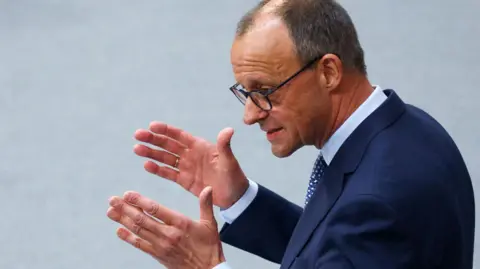
Germany’s incoming new Chancellor, Friedrich Merz, is in a race against time.
The new parliament convenes on 25 March and not everyone is in favour of all this money being spent, especially on defence.
Both the far-right AfD party and the far-left Linke have vowed to oppose it. The vote needs two-thirds in favour to go through, so Merz has a better chance of this happening today, under the existing (old) parliament. It then needs to be approved by Germany’s upper house.
Meanwhile Europe is still coming to terms with the shock of announcements coming from the Trump administration.
At last month’s Munich Security Conference I watched as delegates sat open-mouthed listening to US Vice-President JD Vance’s blistering attack on Europe’s policies on migration and free speech.
This was preceded days earlier by US Defence Secretary Pete Hegseth telling Nato members that America’s 80-year-long defensive umbrella for Europe should no longer be taken for granted.
Defence strategists in Europe are already planning for the unthinkable: a semi-victorious Russia making gains in Ukraine, then rebuilding its army and threatening Nato’s eastern members, such as the Baltic states, within three years or less.
This, at a time when the US commitment to Europe’s defence is looking extremely shaky. President Trump is being urged by some in his circle to pull US troops out of Europe and even to withdraw from Nato altogether.
Historical caution
BBC:
There is talk of France extending its national nuclear deterrent to cover other European nations.
Meanwhile, most European governments are under pressure to raise defence spending after years of cuts.
The British Army has now shrunk to its smallest size since the Napoleonic Wars, over 200 years ago, and experts predict it would run out of ammunition within two weeks of fighting a full-scale conventional war in Europe.
Germany has long been cautious about defence spending, not just for historical reasons dating back to 1945, but also due to the global debt crisis of 2009.
Which brings us back to today’s crucial vote in the Bundestag. It is not just about defence. One part is about freeing up €500bn (£420bn) for German infrastructure – fixing things like bridges and roads, but also to pay for climate change measures, something the Green Party insisted on.
The other part is about removing the restrictions in the constitution on borrowing that could, in theory, free up unlimited billions of euros for defence spending, both for Germany’s armed forces and for a pan-European defence fund. On 4 March European Commission President Ursula Von der Leyen announced plans for an €800bn defence fund called The ReArm Europe Fund.
The proposal being voted on in Berlin is that any spending on defence that amounts to more than 1% of Germany’s GDP (national wealth) would no longer be subject to a limit on borrowing. Until now this debt ceiling has been fixed at 0.35 pct of GDP.
Other countries will be watching closely to see if this proposal passes. If it does not, then the EU Commission’s ‘ReArm Europe’ project could be off to a shaky start.


 Users Today :
  Users Yesterday :
  This Month :
  This Year :
  Total Users : 1392323
 Views Today :
  Total views : 5000
 Who's Online :