

BBC:
In a recent interview, Prime Minister Narendra Modi spoke positively about India’s relationship with long-time rival China. He said normalcy had returned to the disputed India-China border and called for stronger ties.
These are striking comments, because tensions have been high since a nasty border clash in the northern Ladakh region in 2020 – the deadliest since a 1962 war.
Chinese foreign ministry spokeswoman Mao Ning expressed appreciation for Modi’s words and declared that “the two countries should be partners that contribute to each other’s success”.
Modi’s pitch for closer partnership isn’t actually as big of a leap as it may seem, given recent improvements in bilateral ties. But the relationship remains strained, and much will need to fall into place – bilaterally and more broadly geopolitically – for it to enjoy a true rapprochement.
India-China ties have many bright spots.
Bilateral trade is consistently robust; even after the Ladakh clash, China has been India’s top trade partner. They co-operate multilaterally, from Brics, the alliance of major developing countries, to the Asian Infrastructure Investment Bank. They share interests in advancing non-Western economic models, countering Islamist terrorism and rejecting what they deem US moral crusading.
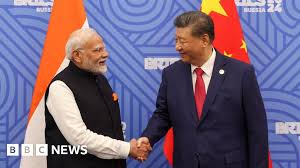
Even after the Ladakh clash sunk ties to their lowest level in decades, the two militaries continued to hold high-level dialogues, which resulted in a deal in October to resume border patrols. Modi met Chinese President Xi Jinping at a Brics summit in Russia that month and they pledged further co-operation. In January, the two sides agreed to resume direct flights.
Still, the relationship remains troubled.
Each side has close security ties with the other’s main competitor: India with the US and China with Pakistan.
China opposes Indian policies in the disputed Kashmir region. Beijing frustrates India’s great power ambitions by blocking its membership in influential groupings like the Nuclear Suppliers Group and permanent membership on the UN Security Council.
China has a large naval presence, and its only overseas military base, in India’s broader maritime backyard.
The Belt and Road Initiative, the connectivity corridor through which Beijing has expanded its footprint in India’s neighbourhood, is categorically rejected by Delhi for passing through India-claimed territory.


 Users Today :
  Users Yesterday :
  This Month :
  This Year :
  Total Users : 1396927
 Views Today :
  Total views : 5000
 Who's Online :