

BBC:
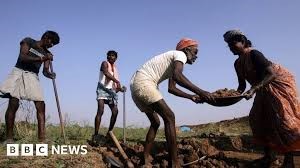
India is home to one of the world’s most ambitious social programmes – a jobs guarantee that gives every rural household the legal right to paid work.
Launched in 2005 by a Congress party government, the National Rural Employment Guarantee Scheme (NREGS) gave every rural household a legal right to demand up to 100 days of paid manual work each year at a statutory minimum wage.
This mattered in a country where 65% of 1.4 billion people live in rural areas and nearly half rely on farming, which generates insufficient income, accounting for just 16% of India’s GDP.
Providing unskilled public work across all but fully urban districts, the scheme has become a backbone of rural livelihoods, cushioning demand during economic shocks. It is also among the world’s most studied anti-poverty programmes, with strong equity: over half of the estimated 126 million scheme workers are women, and around 40% come from “scheduled castes” or tribes, among the most deprived Indians
The ruling Narendra Modi government, initially critical and later inclined to pare it back, turned to the scheme in crises – most notably during the Covid pandemic, when mass return migration from cities to villages sharply drove up demand for work. Economists say the scheme lifted rural consumption, reduced poverty, improved school attendance, and in some regions pushed up private-sector wages.
Last week, the government introduced a new law that repeals and rebrands the scheme. The programme – renamed MGNREGA in 2009 to honour Mahatma Gandhi – has now dropped his name altogether.
While the renaming drew the political heat, the more consequential changes lie in what the new law – known as G RAM G for short – actually does.
It raises the annual employment guarantee from 100 to 125 days per rural household. It retains the provision that workers not given jobs within 15 days are entitled to an unemployment allowance.
Under the original scheme, the federal government paid all labour wages and most material costs – roughly a 90:10 split with the states.
Funding will now follow a 60:40 split between the federal government and most states. That could push states’ contribution to 40% or more of total project cost. The federal government keeps control, including the power to notify the scheme and decide state-wise allocations.


 Users Today :
  Users Yesterday :
  This Month :
  This Year :
  Total Users : 1431321
 Views Today :
  Total views : 5000
 Who's Online :