

BBC:
In the clear blue skies above Abu Dhabi, white contrails streak high above the sand-coloured villas and well-watered gardens.
These are no incoming Dreamliners or Airbuses bringing in the next manifest of tourists and guest workers. They are incoming ballistic missiles, launched by the Emirates’ giant neighbour just across the Gulf: Iran.
As of Sunday afternoon, the United Arab Emirates (UAE) defence ministry said it had so far “dealt with” 165 incoming ballistic missiles, two cruise missiles and 541 Iranian drones.
In Bahrain, a friend alerted me on Sunday morning that the airport was under attack after having a sleepless night.
“Woken by huge bangs and wailing siren,” he texted. “I think maybe around 20 booms and bangs. At least two hits”.
These are not familiar scenes in this region, but since this conflict began on Saturday morning, Iran appears to have expanded its target set from just hitting military targets, like the US Navy’s 5th Fleet headquarters in Bahrain, to airports and other civilian sites.
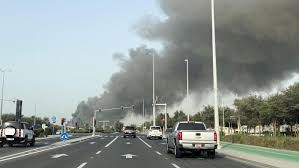
Now luxury hotels and shopping malls, high-rise apartment blocks, state-of-the-art airport departure terminals are getting sporadically hit as gaps appear in the Arab states’ air defences in the Gulf.
These places were never built with the prospect in mind that they would one day come under attack from drones and ballistic missiles.
Iran’s Foreign Minister, Abbas Aragchi, has denied targeting his country’s neighbours, telling Al Jazeera: “We are not attacking our neighbours in the Persian Gulf countries, we are targeting the presence of the US in these countries. Neighbours should direct their grievances to the decision-makers of this war”.
Some of the damage to civilian infrastructure in the Gulf states is accidental – resulting from debris falling from intercepted missiles.
But not all.
The number of attacks on airports in Bahrain and the UAE point to more than coincidence.
Iran always made it clear in advance that, if it was attacked, it would retaliate at any country it considered to be complicit in that attack.
The Gulf states went to some lengths to show Iran they were not part, in their eyes, of this US-Israeli attack.
Yet essentially they have been punished for being long-term military partners of Washington’s.
Before the Islamic Revolution, in the days of the shah, Iran was known as “the policeman of the Gulf”.
Since the revolution, it has always tried to convince its neighbours that it should resume that role, “taking charge of security” in what it calls Khaleej-e-Fars, the Persian Gulf (Arabs call it the Arabian Gulf).
Iranian leaders have tried, unsuccessfully, to persuade the Arab states in the Gulf to expel the US Navy and adopt them as their guardians instead.
But for rulers of the Gulf states – conservative, dynastic monarchies for whom the revolutionary zeal of the Islamic Republic is anathema – a line has been crossed here.
It is hard to see how they can ever have anything approaching normal relations again with the current Iranian leadership, that is, if it survives this war.


 Users Today :
  Users Yesterday :
  This Month :
  This Year :
  Total Users : 1429694
 Views Today :
  Total views : 5000
 Who's Online :