

BBC:
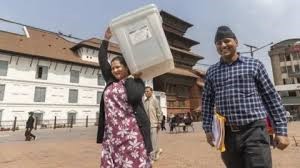
Election officials in Nepal have begun collecting ballot boxes and counting votes after millions of people voted in the country’s general election on 5 March.
The snap election was held six months after deadly youth protests toppled the government in September 2025.
The election commission has begun releasing preliminary results, but it might be days before we see a final tally. This is because the process of collecting ballot boxes from across the mountainous country and delivering them to count centres typically takes at least a day.
It could take another two to three days to tally the results of the proportional representation vote, officials said.
Who is ahead according to early results?
As of 10:00 local time on 6 March, votes counted so far show the Rastriya Swatantra Party (RSP) ahead in most of the constituencies.
Officials are currently tallying numbers for the 165 seats which will be decided via the First-Past-The-Post (FPTP) system. This means the candidates with the most votes wins the seat.
The RSP has put forward rapper-turned-politician Balen Shah as its prime ministerial candidate.
He is taking on KP Sharma Oli in Jhapa-5, a seat long considered safe for the former prime minister, who was unseated in last September’s deadly youth-led protests. Early counting has put Balen – as he is popularly known in Nepal – well ahead in the constituency.
When will we know the final result of the Nepal election?
Ram Prasad Bhandari, the chief election commissioner, says he is committed to finish counting by 9 March.
The election commission has promised to release the full results of the 165 directly elected seats within 24 hours from when counting starts.
It could take another two to three days to tally the results of the proportional representation vote, officials said.
During the last election in 2022, it took nearly two weeks for results to be released.
This is because some polling stations are located in difficult, hilly terrain – more than 80% of Nepal is mountainous – which makes the collection of ballot boxes a challenging logistical exercise.
Some need to be carried down by hand, for instance, while others have to be airlifted in and out of polling stations.
Planes and helicopters are also not allowed into some remote areas after dark, which often means collection can begin only the next morning. Bad weather also interferes with the collection process.


 Users Today :
  Users Yesterday :
  This Month :
  This Year :
  Total Users : 1356045
 Views Today :
  Total views : 5000
 Who's Online :