

BBC:
A protester has said they are willing to “close the country” to get fuel costs down in the Republic of Ireland.
Kildare farmer John Dallon said the protests, which have come in response to high fuel prices caused by the US and Israeli war against Iran, could continue for “weeks”.
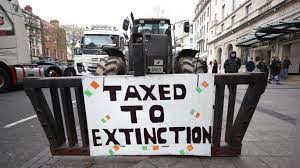
Travel across parts of the Republic of Ireland has been affected for the fourth day in a row on Friday as vehicles, including tractors, block roads.
Dublin Airport passengers are being advised to allow extra time for their journeys a day after people were seen walking with their luggage along a motorway amid ongoing road blocks due to fuel protests.
Dallon, speaking on behalf of protesters in Dublin, told Irish broadcaster RTÉ he believed the protest “could continue on”.
“Maybe for another week, maybe two weeks. If it takes a month, we are prepared to sit here.”
As well as blocking roads, protesters are in place at fuel terminals in Foynes in County Limerick, as well as at Galway Port and a blockade continues at the Whitegate Oil Refinery in east Cork. There is a garda presence there.
Minister for Enterprise, Tourism and Employment Peter Burke told RTÉ he was not aware of any gardaí (Irish police) enforcement against fuel price protesters to date.
Gardaí said on Friday they “continue to engage extensively” with protesters.
The army was asked on Thursday to remove vehicles blocking roads, with the Irish police treating protests at fuel depots as “blockades”.
Irish Minister for Agriculture Martin Heydon and Minister of State Timmy Dooley will meet representative bodies on Friday.
Speaking to BBC Radio Ulster’s Talkback programme, Dooley said there is a “clear understanding that in any democracy that you recognise the importance of a peaceful protest” but added that “some of the protesters have taken it to a new level in taking it to a blockade and that’s where we really do need to see a de escalation”.
He added that the blockades are affecting communities but there is no “simple solution”.
The Irish Minister for Justice, Jim O’Callaghan, said there would be “legal consequences” for some protests.
“It might not arise today or tomorrow but people have licences to drive vehicles, those licences will be affected.”
Fuels for Ireland said that 100 garage forecourts had run out of fuel, mainly in Munster and the west of Ireland.
Its chief executive, Kevin McPartlin, told RTÉ that the number could be five times that by Friday night, adding that 50% of the country’s new supply was being kept behind barricade lines.
The Irish Health Service Executive called for all approaches to medical facilities to be kept clear for people to access treatment and the President of the Irish Medical Organisation, the trade union body, Prof Matthew Sadlier said that potential missed appointments due to the blockades were having a “hugely detrimental” effect on patient welfare.


 Users Today :
  Users Yesterday :
  This Month :
  This Year :
  Total Users : 1417873
 Views Today :
  Total views : 5000
 Who's Online :