

BBC:
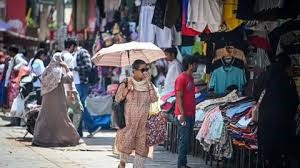
On a scorching afternoon in one of Delhi’s busiest markets, two different worlds exist side by side.
One is inside brightly-lit, air-conditioned showrooms, where customers move slowly between racks of clothes, escaping the worst of the summer heat.
The other is outside, under a blazing sun – where street vendors, fruit sellers, cycle-rickshaw drivers and ice-cream cart operators continue working through temperatures soaring above 40C.
In the afternoon, even walking through the market feels exhausting. But for millions of informal workers across Delhi, staying out of the heat isn’t an option.
Nearly 90% of India’s workforce is informal – most without contracts or job security, many dependent on outdoor work for daily wages.
Among them is 52-year-old Harish Chandra, who pedals a cycle-rickshaw through Delhi’s crowded streets until the heat becomes too much to bear.
At a public tap, he splashes water over his face before settling into a narrow strip of shade near the market.
“The body gives up,” he says.
Dressed in thin, worn cotton clothes, Chandra says Delhi’s summers have become harder to bear with each passing year.
“My day starts around nine in the morning, when the weather is still manageable. But by noon, it becomes difficult. The sun is so harsh that sometimes I feel my body giving up while I pedal,” he says.
“But if we stop, we don’t earn,” says Chandra. “And if we don’t earn, the family doesn’t eat.”
He recently sent his wife and three children back to their village in Bihar state. The temperatures there are equally high, he says, but open spaces and better ventilation make it easier to cope than Delhi’s cramped neighbourhoods and congested lanes.
For workers like Chandra, who spend most of their time outdoors, summer is no longer just a season, but an annual struggle for survival.
India’s heat season typically lasts from April until early July, before the monsoon brings relief. But climate scientists say extreme heat is becoming longer, harsher and more unpredictable as heatwaves across South Asia intensify under global warming.
Dr Soumya Swaminathan, former chief scientist at the World Health Organization, told ANI news agency this week that temperatures now being recorded in India are approaching the limits of “human tolerability” and pose a “threat to both lives and livelihoods”.
Since mid-May, Delhi and surrounding areas have recorded daily temperatures above 40C, at times crossing 45C in the afternoon.
While some relief is expected over the weekend, heatwaves like these have become an increasingly familiar part of India’s summers.
Experts say cities like Delhi are especially vulnerable because of the “urban heat island effect”, where concrete, traffic and limited green cover trap heat and keep cities hotter than surrounding areas.
The weather office and Delhi government have also been issuing regular heat warnings.
On Wednesday, Prime Minister Narendra Modi posted on X urging people to stay hydrated, carry water outdoors and watch for signs of heat exhaustion, especially among children, the elderly and outdoor workers.
Delhi is also among cities with heat action plans. It includes colour-coded heat alerts, public advisories urging people to avoid peak afternoon exposure, water kiosks and cooling centres.
But much of this advice is difficult to follow in practice. Even when temperatures rise, rent has to be paid and food has to be bought.
Mohammad Umar, 50, has been sitting inside his tuk-tuk near a busy traffic signal since morning, waiting for passengers.
He says he rarely takes a day off but last week, the heat finally forced him to stay home.
“My heart was racing and my body had no strength left. I must have bathed five times that day just to stay conscious,” he says.
But missing work comes with a cost.
“On a single day, I can lose 500-700 rupees (around $5-$7) if I don’t work. And we still have to pay for food and daily needs. That money comes out of our small savings,” he says.
A report by the International Labour Organization estimates heat stress could reduce India’s total working hours by 5.8% by 2030, with outdoor workers in agriculture and construction among the worst affected.
A Lancet Countdown report found India lost around 247 billion potential labour hours to heat in 2024, resulting in economic losses of $194bn.


 Users Today :
  Users Yesterday :
  This Month :
  This Year :
  Total Users : 1408846
 Views Today :
  Total views : 5000
 Who's Online :