

BBC:
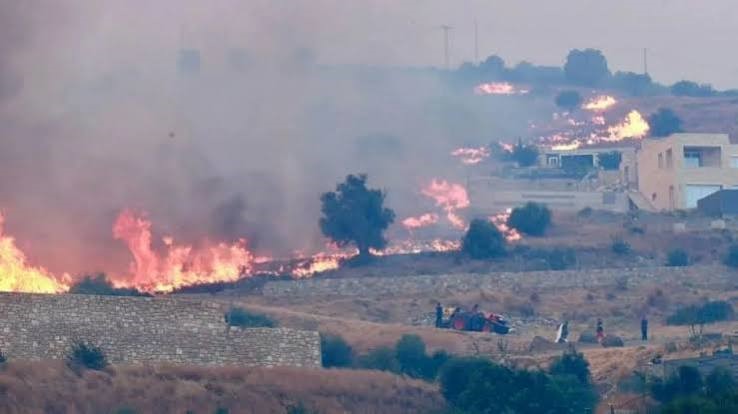
Three Greek firefighters have died tackling wildfires in Crete and in the Peloponnese.
In Crete, gale-force winds whipped up flames prompting the evacuation of several villages, and two firefighters died after becoming trapped when the blaze swept through the Rethymno region, in the island’s west.
Another firefighter died after being found unconscious near the southern Peloponnese port town of Gytheio.
Meanwhile, a fourth heatwave of the summer has begun in Spain and France, with firefighters trying to prevent a flare-up from major wildfires that have only just been brought under control.
Witnesses said several fires broke out on Crete and spread fast, with the worst fire front extending as far as 15km (9.3 miles).
Residents and tourists have been evacuated from Krya Vrysi, the mountain village where the two firefighters died.
“The wind is unbelievable – you can’t stand sometimes. The flames were huge, it was really scary,” resident Chrissa Gioukaki told Reuters.
Wildfires have also broken out elsewhere in Greece, on the islands of Paros and Lesbos in the Aegean Sea, and the southern town of Trifylia on the Greek mainland.
In southern Turkey, the main highway connecting Fethiye and Antalya had to be closed and part of a hospital evacuated because of a fire in Muğla province.
In Spain, Prime Minister Pedro Sánchez has warned the next 12 hours will be “decisive” in putting out a wildfire near the capital Madrid. “Things are progressing favourably, with maximum caution,” he told reporters, because of higher temperatures, lower humidity and the risk of gusts of wind.
More than 43,000 hectares (108,000 acres) has already burned at Burgohondo in Ávila province, 150km (93 miles) west of Madrid. It is now considered the largest recorded wildfire in Spanish history. In total this year more than 207,000 hectares of land have been burned by wildfires in Spain.
One of the team directing firefighting operations, Francisco Bolaños, said that while the fire had not “moved a centimetre during the night”, there were concerns it could re-ignite because of the higher temperatures, and the focus was on stabilising a perimeter of 180km (112 miles).


 Users Today :
  Users Yesterday :
  This Month :
  This Year :
  Total Users : 1477606
 Views Today :
  Total views : 5000
 Who's Online :