

BBC:
Bangladesh’s new government has sought greater Chinese investments and partnership to revive a stuttering economy, even as it attempts to re-balance ties with neighbouring India.
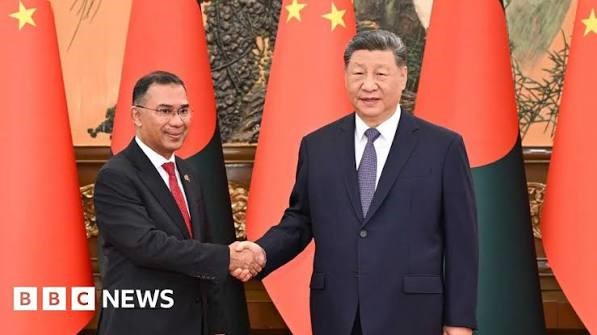
Bangladeshi Prime Minister Tarique Rahman went to Malaysia and China in his first overseas official visit last month, signalling the direction of Dhaka’s foreign policy.
Analysts say the choice of destinations reflects Dhaka’s effort to recalibrate its strategic priorities. While Rahman first visited Malaysia, his trip to China is seen as the more significant.
India has historically been the traditional port of call for newly-elected South Asian leaders. Some in India have viewed Rahman’s China visit as a message to Delhi which has maintained close ties with the ousted Bangladeshi leader Sheikh Hasina.
Among several bilateral agreements, Rahman’s outreach to Beijing for help managing the Teesta River and a deal to develop a special economic zone near Mongla port have attracted particular attention.
These are closely watched in Delhi as the two Asian giants compete for influence in Bangladesh.
Relations between Dhaka and Delhi turned frosty after the overthrow of prime minister Sheikh Hasina in August 2024 in a mass uprising. She fled the country and took refuge in Delhi.
Diplomatic ties remained strained after the interim government led by Muhammad Yunus took office, with India avoiding high-level visits.
After Rahman took over following a landslide victory for his Bangladesh Nationalist Party (BNP) in February, both sides have taken initiatives to reset their ties.
“There is no doubt there has been a relative relaxation of tensions between the two countries,” former Indian foreign secretary Shyam Saran told the BBC.
“The cross-border economic activities are gradually returning to normal and India is also issuing tourist visas to Bangladeshis,” he said.
Passenger bus services between India and Bangladesh have partially resumed after an 18-month gap. Services now operate between Kolkata and Dhaka, and between Dhaka and Agartala.
When the war in the Middle East broke out earlier this year and hit global fuel supplies, Delhi sent thousands of tonnes of emergency fuel via the cross-border Friendship Pipeline to Bangladesh.
Last month, India’s new High Commissioner to Dhaka, Dinesh Trivedi, took charge. In a rare move, Delhi elevated him to cabinet rank, signalling its intent to reset bilateral ties.
Despite diplomatic tensions and the two countries imposing tit-for-tat restrictions on trade when the interim government was in power, bilateral trade last year stood at around £13bn, mostly in India’s favour.
Nevertheless, the rapprochement between Dhaka and Delhi is not as expected and there are continuing irritants in the bilateral relationship.
A strong anti-India sentiment, mainly for supporting Hasina, and attempts by the Indian Border Security Force to push people, who they deem as illegal immigrants, into Bangladesh have triggered controversy and anger in Dhaka.
Bangladeshi officials say India has pushed in thousands of people, mainly Bengali-speaking Muslims, in recent years without following any due repatriation process.


 Users Today :
  Users Yesterday :
  This Month :
  This Year :
  Total Users : 1389084
 Views Today :
  Total views : 5000
 Who's Online :